The Formation Number Is Not a Map
A football formation is a starting arrangement, not a fixed map: learn to read how roles and positions shift as possession changes hands.
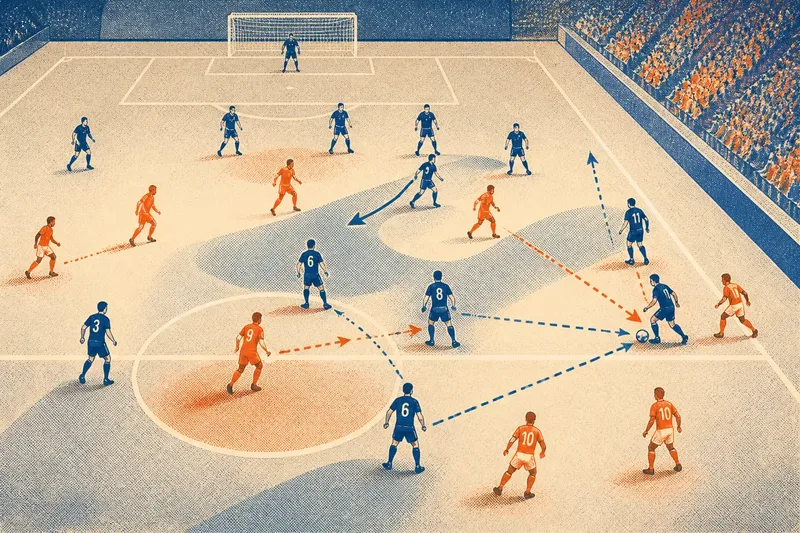
The common mistake in reading a football formation is to treat its number as a map of where every player must stay. That can make a match look like a set of static lines, hiding the movements that shape its tempo and leave space open—or close it. A formation is better read as the team’s starting arrangement, with its positions changing as the ball moves and possession turns over.
What does a formation number actually tell you?
A label such as 4-3-3 or 4-2-3-1 describes the broad distribution of outfield players when a team is arranged in a particular phase. It can help you anticipate who might occupy the forward line, who begins in midfield and how many defenders are set behind the ball. It does not tell you the full story of a player’s job, or promise that the same spacing will persist throughout a passage of play.
Consider the number a little like the seating plan for a busy dinner: useful before people start getting up to pass dishes, change seats or make room. On the pitch, those changes are not incidental. A wide player may move inside, a full-back may advance, and a midfielder may drop towards the defence. Each movement changes the team’s shape and the work its teammates must do around it.
How does one shape change during a match?
Imagine a clearly hypothetical match in which Harbour Athletic begin in a 4-3-3 against Calder Town. Harbour’s back four starts in a familiar line, with a holding midfielder ahead of them, two more central midfielders and three forwards. Calder press the first pass, trying to hurry Harbour into playing long.
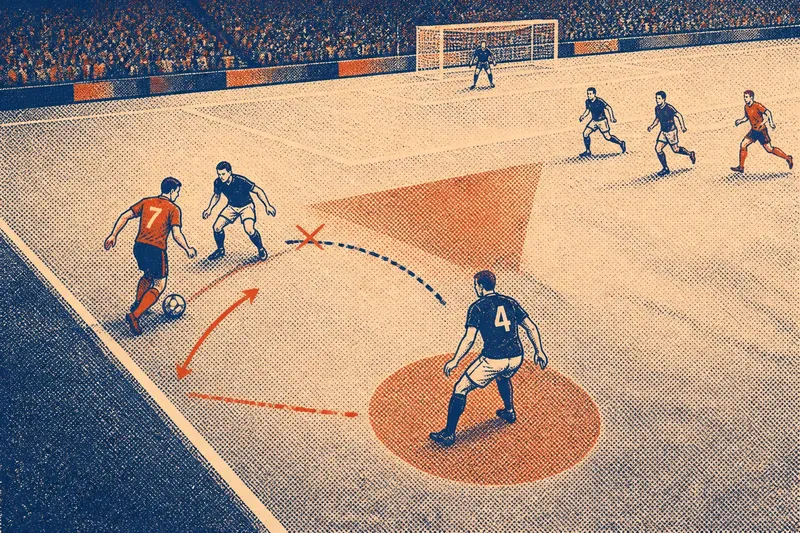
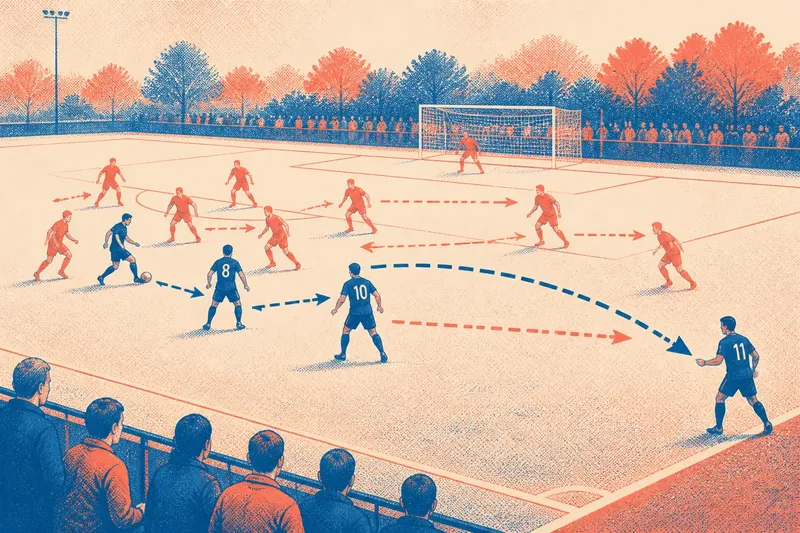
Harbour’s right-back moves forward to offer an outlet. The right-sided forward comes infield, while the right central midfielder shifts towards the touchline to keep a passing option open. The holding midfielder stays deeper, giving the two central defenders a safer route to circulate the ball. The arrangement no longer resembles three evenly spaced forwards and three midfielders. Yet the team has not abandoned its starting idea: it has altered positions to solve a particular problem.
That adjustment has a cost. If Harbour lose the ball while the right-back is high, Calder can try to play into the space behind him. The deeper midfielder may have to slide across, and a central defender may be tempted to leave the line to cover the run. Harbour’s next decision is shaped by the previous one: keep the right-back advanced and accept the exposure, or ask him to hold a more cautious position and give up some width in attack.
What happens when possession changes?
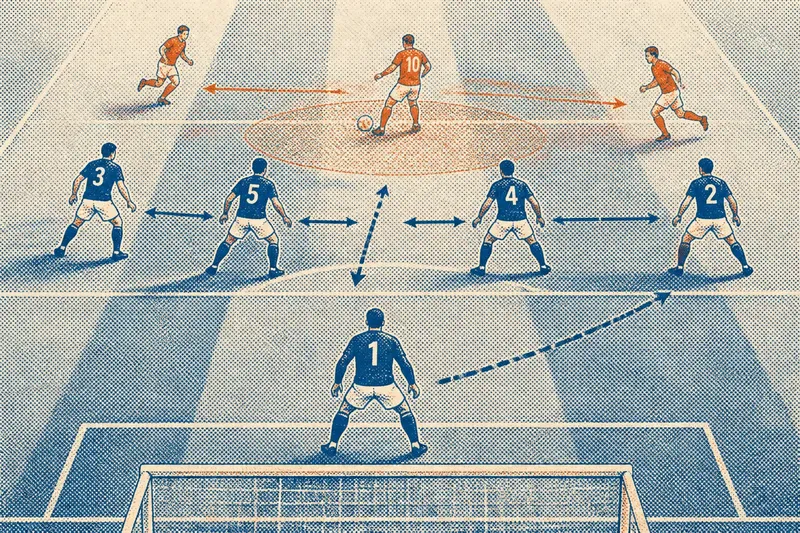
Calder win the ball and immediately send a pass into the channel behind Harbour’s advancing right-back. The nearby central defender shifts out, while Harbour’s holding midfielder tracks back towards the space in front of the penalty area. The left-back narrows towards the centre to help protect the goal. For a moment, Harbour’s defensive shape is less like their attacking arrangement and more like a compact line with midfielders recovering around it.
Their nearest forward also has a choice. He can press Calder’s player on the ball, aiming to slow the attack, or retreat to help restore a line across midfield. If he presses alone, Calder may pass around him. If he drops, Calder has more time to pick a forward pass. Neither action is dictated by the formation number; the choice depends on distance, timing, teammates’ positions and the danger of the next pass.
Calder’s attack slows, and Harbour recover their positions. The right-back returns towards the defensive line, the central defender moves back inside, and the holding midfielder settles in front of them. Harbour have not simply switched from one diagram to another. Their shape has been rebuilt in response to the ball’s route and the space Calder threatened.
How can you tell which positions are temporary?
Watch the same player across several phases rather than deciding what a role means from one snapshot. Ask where the player begins when Harbour have settled possession, where he moves when a teammate advances, and what he does when Calder regain the ball. A midfielder who briefly drops between defenders may be helping to build an attack, not taking on a permanent defensive position.
It also helps to follow the players who react to that movement. When the right-back advances, does the right-sided midfielder cover behind him? Does the nearest forward move inside to open the touchline? If the ball is lost, who presses first and who falls back? Those responses reveal the team’s working arrangement more clearly than the formation label alone.
Tempo is part of the picture, too. A team that moves the ball quickly may change its shape before the opposition can adjust. Slower circulation can give both sides time to settle into more recognisable lines. The number on the team sheet cannot explain that difference; the sequence of passes and movements can.
Which questions help you read a changing formation?
Does the formation change every time a player moves?
No. A shift by one player may be a local adjustment within the same broad plan. Look for repeated changes in the team’s spacing and responsibilities before treating a momentary movement as a new formation.
Why do teams use different shapes with and without the ball?
Attacking and defending present different problems. A team may spread out to create passing routes in possession, then contract to protect central space when the opponent has the ball.
Can one player change the team’s shape?
Yes, if teammates respond to the movement. A full-back moving forward can prompt a midfielder to cover, a forward to drift infield and the far-side players to adjust their spacing.
Is the formation label still useful?
Yes: it gives a concise starting point for describing a team’s broad arrangement. It becomes misleading only when treated as a complete account of where players stay or how they respond to changing play.
What should you take from Harbour’s adjustment?
In the imagined passage, Harbour’s original arrangement helped them begin building from the back, but their positions changed when Calder pressed, when the right-back advanced and when possession was lost. The useful question was not whether the team remained a 4-3-3 at every instant. It was how each movement changed the available pass, the exposed space and the responsibility of the nearest teammate.
When reading a formation, start with the label, then follow the ball and the players who respond to it. Notice which positions are held, which are exchanged and which are recovered after a turnover. That is how the formation number becomes a starting clue rather than a map—and how the changing tempo of the matchup comes into view.