When the Sweeper Became a Role Behind the Line
Sweeper as a role behind the line changed how defenders covered danger and pressed forward; learn to spot its trade-offs and diagnose defensive gaps.
The common mistake is to treat the sweeper as an extra defender who simply waits behind the others. That can cost a team its connected press: opponents may find room between midfield and defence while the back line hesitates. A sweeper’s value depends on how the player’s cover relates to the movement ahead, not on standing deep by itself.
The role has taken different forms across football, so it is safer to describe its tactical function than to claim one universal historical shift. In a classic arrangement, a sweeper operated behind other defenders, covering passes or runs that breached their line. The position offered insurance, but demanded early reading of danger and clear communication with teammates.
What changes when a sweeper stays behind the line?
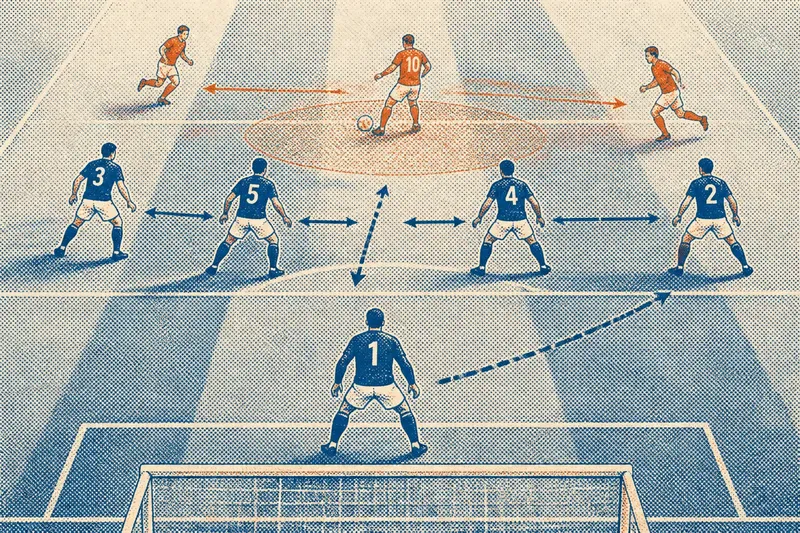
In a coordinated defensive line, defenders use one another and the ball as shared reference points. When they step forward together, they can make space behind them harder to reach. A sweeper adds another reference point: a player deeper than the line, responsible for covering routes the others cannot reach.
That player may cover a forward running into open ground, but the arrangement changes the defenders’ choices. One defender may challenge for the ball, expecting cover behind. The sweeper must then judge whether to close the attacker, protect the route to goal or shift across to help a teammate. Those decisions depend on what the rest of the defence is doing.
Think of a doorstop behind a door: it can limit an unwanted swing, but it cannot tell the person at the handle when to move. A sweeper may reduce the danger of a breached line; the role cannot replace shared decisions about pressure, tracking and movement.
Why can the back line stop pressing together?
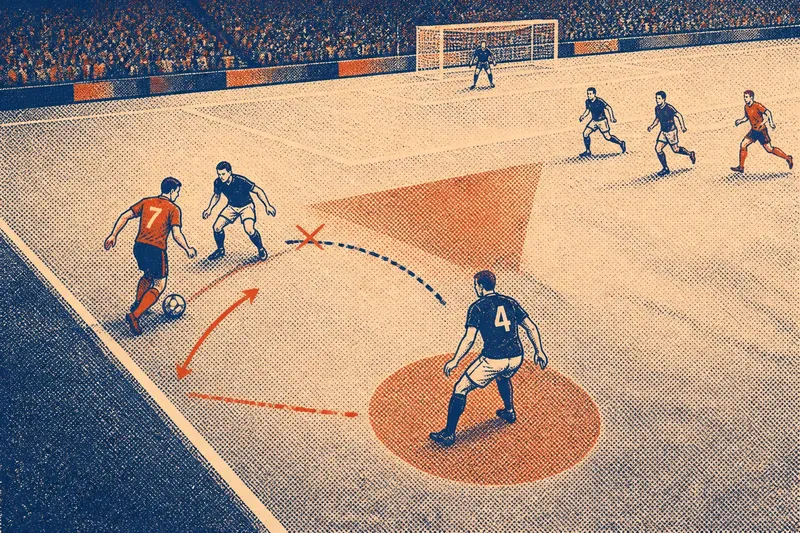
A defender moves towards the opponent on the ball while the sweeper retreats to guard space behind. The other defenders may hesitate: should they support the challenge, hold their positions or drop back? That split response can open a lane between midfield and defence.
Often, the difficulty is unclear responsibility for the first action. If a defender engages the ball carrier, teammates need a shared cue for whether to step forward or retreat. Without communication, a sweeper’s cover can become a separate unit rather than support for a connected line.
When reviewing play, focus on a pass travelling towards an opponent who is facing away from goal. Do the nearest defender and the players either side move together while the sweeper adjusts behind them? If only one defender advances, the team may need a clearer cue for pressing or dropping; if the line moves together, check whether the receiver’s next action is restricted.
What if the sweeper is too far from the danger?
A player can protect an area instead of responding to the developing threat. A forward may receive in front of the defence, turn and run at it while the sweeper stays deep, guarding space that is not yet under immediate attack. The defenders then face the ball without close support behind their challenges.
This distance can grow when the line is unsure about stepping up. Defenders retreat to avoid a pass over their heads, and the sweeper moves further back to preserve a cushion. An opponent may then have time to receive between midfield and defence and choose a pass, shot or run.
Track the sweeper in relation to the ball and the nearest forward, not just the goal. If the forward receives with their back to goal and the sweeper remains so deep that a teammate must defend alone, the cover may be poorly connected. If the opponent has time and space to threaten behind, the sweeper may need to protect that route instead of stepping closer.
How can cover make forward pressure hesitant?
Cover is meant to let defenders engage with confidence, yet it can have the opposite effect if players expect the sweeper to repair every mistake. A defender delays a challenge, expecting the sweeper to deal with the receiver; the sweeper waits for the defender to act. The opponent gains time because both players are protecting themselves from the same uncertainty.
There is a related risk when the sweeper moves towards the ball before the line has stepped up. A pass or run into the space left behind can expose the goal. The issue is not that the sweeper joins the action; it is whether that movement fits the defenders’ pressure and the attacker’s options.
In a match review, pause just before a defender commits. If the covering player has no clear route to the next danger, the defender may need support closer to the ball; if the line is too stretched to offer that support, the team may need to stay compact rather than send a player out alone.
Why can quick changes of direction expose the cover?
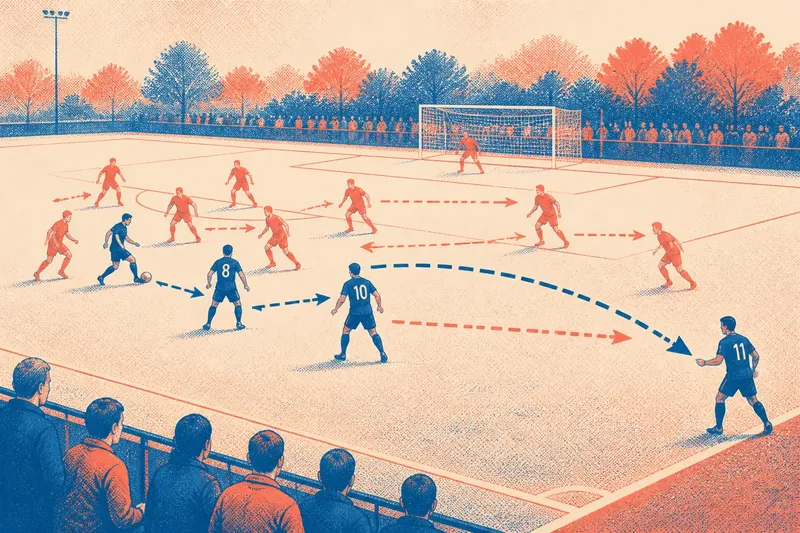
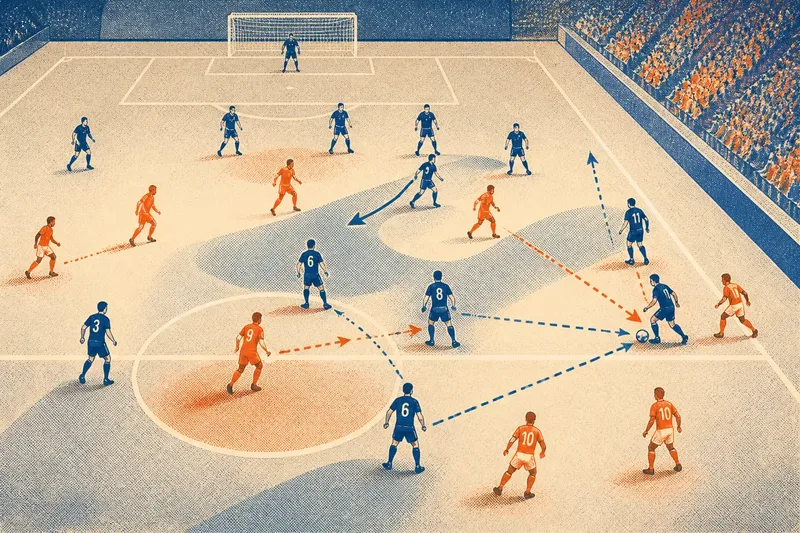
An opponent may draw the defence towards one side, then switch the ball or run into space on the other. The sweeper has to adjust across the pitch as the line repositions. A delayed shift can leave a gap between the covering player and the nearest defender.
This is harder when the ball carrier can pass forward without pressure. The sweeper may see a run developing but lack the angle or time to prevent the pass. If the defenders ahead are far apart, the covering player must choose between closing the runner and protecting the central route to goal.
Watch whether the sweeper starts moving as the ball travels, rather than waiting for the receiver to control it. If the player shifts early but the line does not, the defence remains disconnected; if both move together, check whether the ball carrier is under enough pressure to make the switch difficult.
How can you tell whether the sweeper is helping?
Do not judge the role solely by a dramatic last intervention. Follow the sequence that leads to danger: did the line pressure the ball, did the covering player respond, and did the opponent have a clear route through or around the defence? Quiet cover can help when it gives teammates confidence to press and denies a forward a clean run behind.
Say a team’s centre-back steps towards a forward receiving between the lines, while the player behind shifts across to cover the forward’s path towards goal. The other defenders move with the challenge instead of retreating separately. The expected observable result is less room for the receiver to turn and fewer open routes forward; this is an invented situation, not proof that the system will stop every attack.
What should you check when assessing a sweeper?
- Check whether the nearest forward is running behind the line. If the sweeper tracks that route, keep the cover in place; if the threat is in front, adjust the line’s support rather than guarding empty depth.
- Check whether the defender nearest the ball steps out alone. If the others move with them, keep the shared pressing cue; if they retreat separately, clarify whether the line should step or drop.
- Check whether the sweeper shifts as the ball changes sides. If the player moves with the threat, maintain the connected shape; if the shift comes late, agree who covers the far-side route.
- Check whether the ball carrier has time to pass forward. If they are under pressure, the sweeper can focus on the likely run; if they have time, the team may need to close the ball before relying on cover.
- Check whether a forward can receive and turn between midfield and defence. If the sweeper can support the challenge, keep that distance; if not, bring the defensive support closer or compress the space in front.
- Check whether defenders hesitate because they expect the sweeper to solve every problem. If roles are clear, continue the pressure; if both players wait, assign who engages and who covers.
What do readers often ask about the sweeper role?
Where does a sweeper stand?
A sweeper generally operates behind the other defenders, but the exact position changes with the ball, the attackers and the defensive line. The useful question is whether the player can cover the next danger without leaving the line disconnected.
Is a sweeper the same as a centre-back?
Not exactly: centre-back describes a defensive position, while sweeper describes a covering function behind other defenders. A player in a centre-back role may provide cover, but the labels do not always mean the same arrangement.
Does every team need a sweeper?
No. A team can share the covering task through defenders moving together rather than assigning one player to stay behind the line. The choice depends on how the team wants to press, protect space and manage runs behind.
Why did the sweeper become less distinct?
There is no single change that explains every team’s tactics. Where a team defends with a connected line and presses higher, leaving one player permanently detached can create space between defence and midfield, so teammates may share the covering work through coordinated movement.
Why did the role become less distinct?
The sweeper’s deeper position could provide cover, but it also placed a premium on reading danger early and communicating with teammates. In some tactical arrangements, a permanently detached player could leave too much space between defence and midfield, particularly if the rest of the team wanted to defend higher as a connected unit. The covering task did not disappear; it could be shared through coordinated movement instead.
That is why the sweeper is best understood as a relationship, not a landmark. Follow the connection between the defender who challenges, the player who covers and the space an opponent is invited to use. For anyone searching for “sweeper role behind the line”, that connection is the clearest way to judge whether cover supports forward pressure or quietly holds it back.