The Second Defender: Why Cover Changes a One-on-One
The second defender changes a one-on-one by shaping the attacker’s options. Learn how to read the cover position and judge the whole defensive matchup.
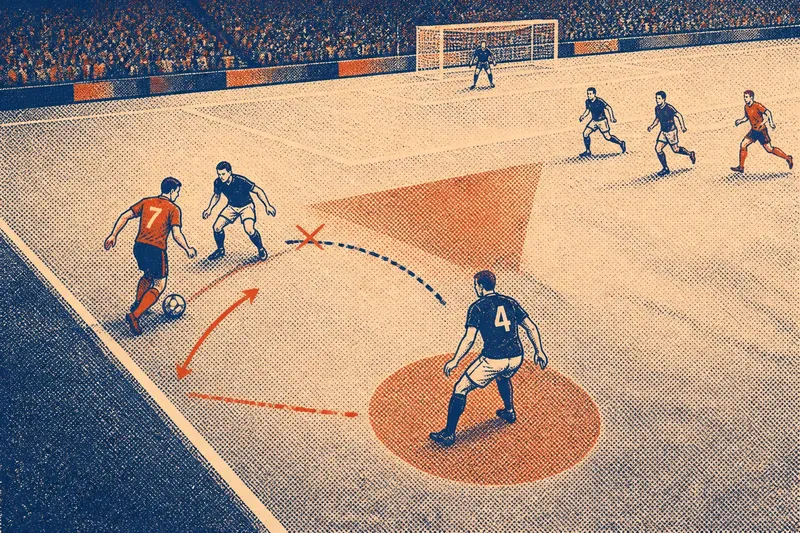
The common mistake when reading a one-on-one is to watch only the defender facing the ball. That can make a well-organised defence look beaten, or a stranded defender look protected; the second defender may be quietly closing the route that matters most. To read cover in a football matchup, track where that supporting player stands and what choice the attacker still has.
What does the covering defender change?
The first defender engages the attacker, applying pressure and trying to control the direct route forward. The covering defender stays behind or inside that challenge, ready to deal with the move that gets past the first player. Their position changes the attacker’s menu: a tempting turn may run straight into cover, while a pass or retreat may be the sensible way to keep possession.
This is why the visible duel is not the whole matchup. The attacker is making decisions against a pair, even when only one opponent is close enough to tackle. Think of a doorstop behind a door: it does not make the door impossible to move, but it changes how far it can swing.
Cover is not simply “another defender nearby”. A teammate who is level with the first defender, screened by an opponent, or too far away to influence the next action may offer little practical support. Read the space between the players and the route to goal, not just the head count.
Which situation are you watching?
Sort the scene by the covering defender’s position and the attacker’s immediate options. These cases help explain why the same apparent one-on-one can invite very different choices.
- Cover is close and inside: The second defender blocks the direct path towards the centre or goal. This suits a defence trying to show the attacker towards the touchline, where the available space and passing angles may be narrower.
- Cover is behind but offset: The first defender can engage more firmly because a teammate is positioned to respond if the attacker slips past. This fits a situation where the defence wants to challenge for the ball without leaving the route behind completely open.
- Cover is distant or screened: The first defender has little protection against a dribble into the space behind. This suits a cautious reading of the duel: the defender may delay rather than lunge, buying time for support to arrive.
- Cover is drawn towards another threat: The attacker may have room to pass, combine or change direction because the second defender cannot commit freely. This fits a scene where the defence must weigh the ball-carrier against an overlapping runner or a nearby passing option.
These are reading cues, not fixed laws. A defender’s angle, the attacker’s stronger foot, nearby teammates and the distance to goal all affect which route is actually dangerous.
How does cover shape the first defender’s approach?
With reliable cover behind, the first defender can often close the ball more assertively. The cover player is positioned to respond to a touch past the challenge, so the first defender can try to force an early decision. If the support is missing, a rushed tackle can leave open space for the attacker to exploit; staying balanced and delaying may be the more useful response.
Watch the defender’s hips and feet as well as their distance from the ball. A side-on stance can steer the attacker towards a particular channel while keeping the defender ready to turn. If the defender faces square-on and reaches in, the attacker may be able to shift the ball across them. Cover affects the risk of that choice, but it cannot make poor body positioning harmless.
Imagine a winger receives the ball near the touchline, with a full-back in front and a centre-back tucked several steps behind and inside. The full-back angles their run to block the route towards the penalty area, while the centre-back protects the space behind. The winger may then pass back or try the line; the observable result is a narrower set of routes, not an automatic loss of possession.
What should you track after the attacker moves?
Follow the cover player’s next adjustment. If the attacker cuts inside, does the second defender step across to close that lane, or hold position to protect a runner behind? If the attacker goes down the outside, does the cover shift towards the crossing route? The answer shows which threat the defence has chosen to prioritise.
Also watch whether the first defender can recover into the play. A successful cover action might delay the attacker long enough for the original defender to get goal-side again. In that moment the pair can switch jobs: the first defender becomes cover, while the teammate who stepped across engages the ball. That exchange is easy to miss if you stop watching once the dribbler passes the first opponent.
Which questions help you read the cover?
Does the covering defender need to be directly behind the first defender?
No. The best position depends on the danger the defence is protecting against. A player slightly inside may guard a cut towards goal, while one set deeper may be better placed to deal with a ball played into space.
Can an attacker still beat two defenders?
Yes. A change of pace, a sharp touch or a well-timed pass can defeat the pair, especially if their spacing is poor. Cover narrows or redirects options; it does not remove the attacker’s skill or make the outcome certain.
Why might the second defender leave the one-on-one?
The defender may have to track a runner, protect another passing lane or stay close to a central threat. Their apparent absence from the duel can reflect a different responsibility, rather than a failure to provide support.
What is the clearest sign that the cover is working?
Look for the attacker being guided away from the most dangerous route or having to release the ball before reaching it. The defence may still concede a pass or a cross, but the covering position has influenced where and when the next action happens.
When does cover fail to help?
Cover can arrive too late, stand too close to the first defender, or leave a gap between the two players that the attacker can split. It can also be pulled out of shape by a second attacker. In these situations, the supporting defender’s position may offer reassurance without an effective route to intervene.
Judge the distance in relation to the attacker’s speed and the available space, rather than treating any particular spacing as ideal. If the attacker can reach the gap before the cover player can shift across, the pair are not functioning as a unit in that moment. If the cover player is too near, one change of direction may take both defenders out of the action.
To read the second defender well, keep the ball-carrier, the first defender and the supporting player in the same view. Ask which route the first defender is showing, which one the second defender is protecting, and what the attacker can still do next. That is the useful way to read a one-on-one: not as a private duel, but as a contest over the options the defenders leave open.